
The structure of the problem
Platform owners have a recurring problem. Their distribution channel is their most valuable asset — the thing that makes them essential — and that channel always faces a temptation: promote the products that compete with the ones they sell.
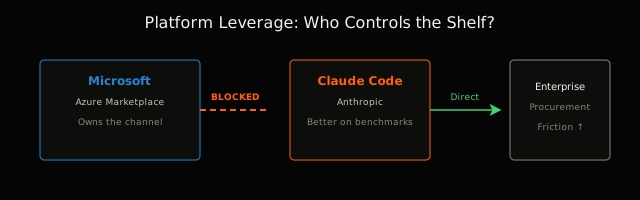
The logic is straightforward. Microsoft controls Azure Marketplace. GitHub controls Copilot. If a competitor’s product becomes popular on their platform, that platform gets credit. But if the competitor’s product is better, the platform’s own product loses. The platform owner has to decide: are they a distributor or a competitor? They can’t fully be both without creating a conflict of interest that eventually resolves in only one direction.
This is the structural tension worth understanding before you build anything on a platform you don’t control.
The playbook is old
Platform leverage has a well-documented playbook. I’ve seen it run in every major software platform shift:
Apple blocks competing browser engines on iOS. The App Store rules explicitly prohibited alternative rendering engines until regulatory pressure forced a change. Safari wasn’t winning on merit — it was winning by default.
Google prioritizes its own products in search results. The “duplicate content” filters, the “original source” attribution, the local product results that favor Google Shopping — none of these are coincidence. They’re platform prioritization dressed up as quality signals.
Amazon buries popular products that compete with Amazon Basics. Third-party sellers who build products that Amazon wants to private-label discover their search rankings mysteriously drop right after they start running meaningful volume.
Microsoft has done this with every major platform transition. Windows vs OS/2. Internet Explorer vs Netscape. Azure vs AWS. The pattern is consistent: use the platform to make competing products administratively painful, not technically impossible.
The move is always the same: use distribution leverage where technical excellence would be uncertain. Win on convenience, not on merit.
The AI coding tools market is susceptible
Here’s why the AI coding tools market is particularly susceptible to platform leverage:
Enterprise procurement runs through marketplaces. Large organizations have vendor onboarding processes, security review requirements, and procurement policies that make it easier to buy through an approved marketplace than directly from a startup. If your product gets delisted — or never listed — a significant fraction of the enterprise market effectively doesn’t have access to you, no matter how good you are.
Developer habit is sticky once installed. Once a team has configured an AI coding tool into their workflow, the switching cost is real. IDE integration, team conventions, review workflows — these are not trivial to change. Platform owners know that if they can get their tool into the dev flow early, the switching cost becomes a moat.
Benchmarks don’t determine procurement. The SWE-bench scores that show Claude Code outperforming Copilot are real and well-documented. But enterprise procurement doesn’t buy based on benchmarks. It buys based on vendor relationships, procurement policies, and who they already have an enterprise agreement with. Platform leverage works precisely because it exploits the gap between technical merit and procurement reality.
What “duplicative functionality” actually means
The phrase deserves attention because it’s not about technical substance. It’s about market control.
Claude Code and GitHub Copilot are not duplications of each other. Claude Code is a terminal-native autonomous coding agent. GitHub Copilot is an autocomplete-and-chat tool in an IDE sidebar. They overlap in the same sense that a Ferrari and a minivan both move people down a road — technically true, practically misleading.
What “duplicative” really means in the context of platform procurement is: “this product competes with our product in a context where our platform controls the purchasing decision.” The platform owner isn’t saying the competitor’s product is bad. They’re saying: “we control the store, and we prefer our products to win.”
The move that follows is always the same: remove the competitor’s listing from the marketplace, introduce friction into direct purchasing, or change the terms of access. None of these are technically necessary. They’re administratively convenient.
The response options
When a platform owner uses distribution leverage against your product, you have four real options:
Build a direct enterprise motion that neutralizes marketplace dependency. The counter to platform control is a white-glove enterprise onboarding process that handles everything procurement needs: security questionnaires, SOC 2 reports, customized terms, single sign-on integration, consolidated billing. Make buying direct easier than buying through a marketplace. Remove every piece of friction that platform leverage adds. This requires investment, but it’s the only durable response.
Invest in deployment flexibility. If your tool currently requires a marketplace, ship a self-hosted option for regulated industries. Ship a containerized version that integrates with enterprise DevSecOps pipelines. Make the argument that your tool is infrastructure, and infrastructure should live outside the politics of marketplace listings. If your product requires their platform to function, their platform can always make it function less conveniently.
Make the competitive comparison public and undeniable. Commission an independent audit: blind study, real-world coding tasks, experienced developers, comparing your product against the platform owner’s product head-to-head. Then publish the results as a PDF that any enterprise procurement team can attach to a vendor evaluation. Make it politically costly for the platform owner to hide behind “duplicative functionality” when the data shows otherwise.
Partner with every platform competitor. AWS, Google Cloud, GitLab, JetBrains. Build deep integrations with every platform that has a reason to compete with the dominant player’s developer tools ecosystem. Turn the dominant platform’s leverage into a reason to diversify and accelerate their competitors’ adoption. The goal is to make sure your product runs well everywhere, so platform leverage in one direction doesn’t cut off your access to the market.
The developer sovereignty question
There’s a reason this dynamic is worth understanding beyond the immediate competitive picture. Developers have choices about where to run their tools, where to buy their licenses, and how much friction to accept from platform owners. That choice is increasingly where the actual leverage sits.
The platform owner can control the store and the product, but they can’t control what developers do in the terminal. The terminal is sovereign in a way that marketplace listings aren’t. Developers who understand the platform leverage dynamic can make intentional choices about where to run their tools and how much procurement friction they’re willing to accept.
Platform wars in AI dev tools are coming. The first visible move is this dynamic playing out in real time. But developers who understand what’s happening can navigate it deliberately rather than discover it by surprise.
Bottom Line
Platform leverage in AI coding tools is a real dynamic and worth understanding before you build your workflow on a platform whose owner also sells competing products. The risk isn’t that the platform owner’s product will beat your preferred tool on merit — it’s that they can make it administratively painful to buy the better product while making their own product more convenient. Build your workflow portability into your tooling decisions now. The platform wars in developer tools are just beginning.The terminal is still open
Platform leverage is real, but developer sovereignty is also real. The developers who have experienced terminal-native autonomous coding and prefer it to autocomplete-in-a-sidebar understand this viscerally. No marketplace policy changes that. The question is whether the tools we prefer can build the enterprise bridge around the blockade — the direct purchasing motion, the partner ecosystem, the documentation that makes procurement friction transparent and navigable.
If they can, platform leverage becomes an irrelevance. If they can’t, it becomes a reason to diversify. Either way, the message is clear: when platform owners compete with the products on their own shelves, the shelf gets narrower. Build accordingly.
Resources
- GitHub Copilot Documentation — https://docs.github.com/en/copilot
- Anthropic — Claude Code Documentation — https://docs.anthropic.com/en/docs/claude-code
- SWE-bench Leaderboard — https://www.swebench.com/
- Azure Marketplace — https://azuremarketplace.microsoft.com/